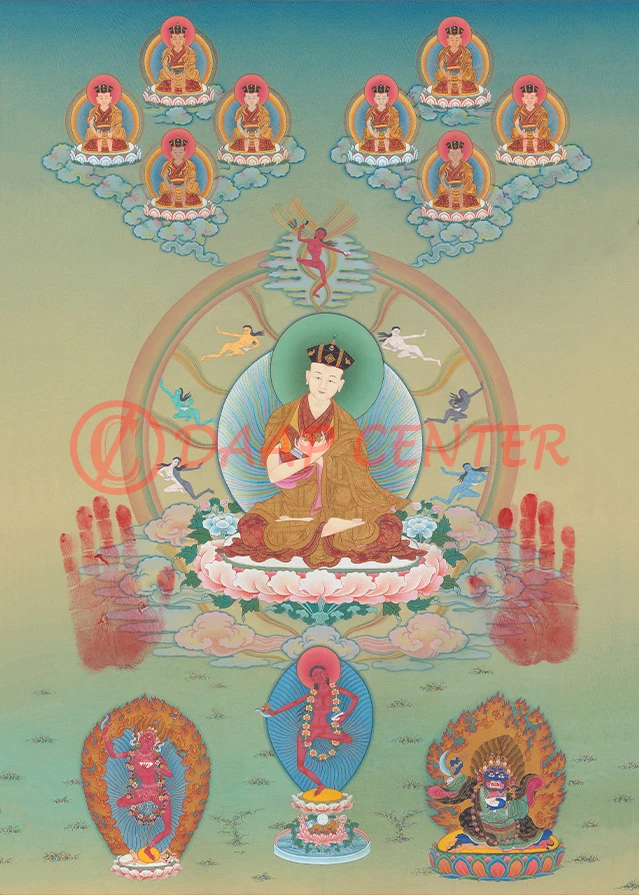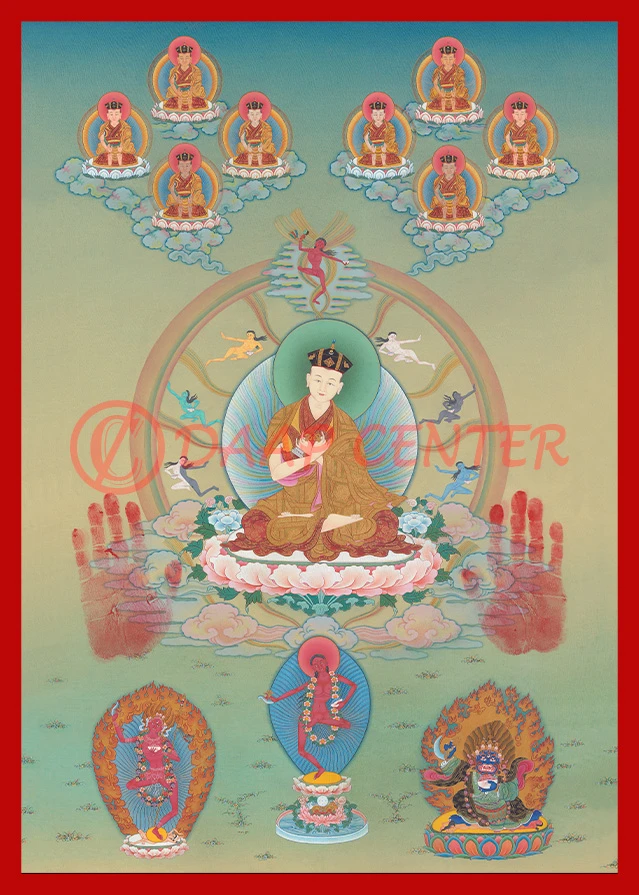
This sacred thangka depicts Jetsün Mikyö Dorje (1507–1554), the Eighth Karmapa, as the central source of the Four-Session Guru Yoga. Designed specifically as a visual support for the Four-Session Guru Yoga practice, the composition functions as a contemplative mandala—a direct means of encountering the guru as the embodiment of all Buddhas, yidams, and wisdom ḍākinīs.
Mikyö Dorje is seated at the center in vajra posture (vajrāsana) upon a lotus base throne with sun and moon discs, signifying the inseparable union of compassion (method) and wisdom (emptiness). His unwavering posture expresses the immutability of the enlightened state and the perfect stabilization of inner energies within the central channel.
Adorned in saffron monastic robes and the black Vajra Crown (Black Hat) —the distinctive emblem of the Karmapa lineage.
His countenance conveys wrathful joy and profound meditative absorption, revealing awakened power grounded in compassion.
At his heart, his hands are crossed in the Vajra Humkara Mudra, holding the Vajra and Bell, the definitive symbol of the indivisibility of method and wisdom and the essence of Mahāmudrā realization.
The Rainbow Aureole: Behind him is a radiant Ja-lus (Rainbow Body).
signifying the union of appearance and emptiness and affirming the guru as a manifestation of pure wisdom-energy rather than an ordinary corporeal being.
Encircling the central figure is a multicolored circular field within which the seven dancing Wisdom Dakinis (Yeshe Khandroma) are depicted, forming a mandalic display of enlightened awareness and activity. They signify the dynamic expression of the Guru’s realization, showing that awakened mind naturally manifests as compassionate, liberating activity. Their presence emphasizes that realization is not static, but actively benefits beings.
At the base of the composition appears Wisdom Dakini (Yeshe Khandroma) at the center, flanked by the protector Bernagchen (Black Cloak Mahakala) on the right and Vajrayogini on the left. Together, they safeguard the practice and the lineage, anchoring the
visualization and affirming the stability, continuity, and protective power of the Karma Kagyu transmission.
The thangka is further consecrated by the sacred red handprints of H.H. the 17th Karmapa, Ogyen Trinley Dorje. These imprints serve as a living lineage seal, transforming the painting into a Kutshab (Representative of the Body). Through this blessing, the thangka becomes not merely a representational image, but a direct conduit of ongoing transmission, blessing, and realization.
This thangka serves not merely as an object of devotion, but as a complete visual support for the Four-Session Guru Yoga. It guides the practitioner to recognize the Guru as the totality of awakened mind—the union of all Buddhas, Wisdom Dakinis, and Protectors. Through sustained contemplation and devotion, the visualization becomes a direct means for meditative absorption, in which devotion matures into realization. In this way, the practitioner’s own awareness is gradually unified with the enlightened mind of the Guru.