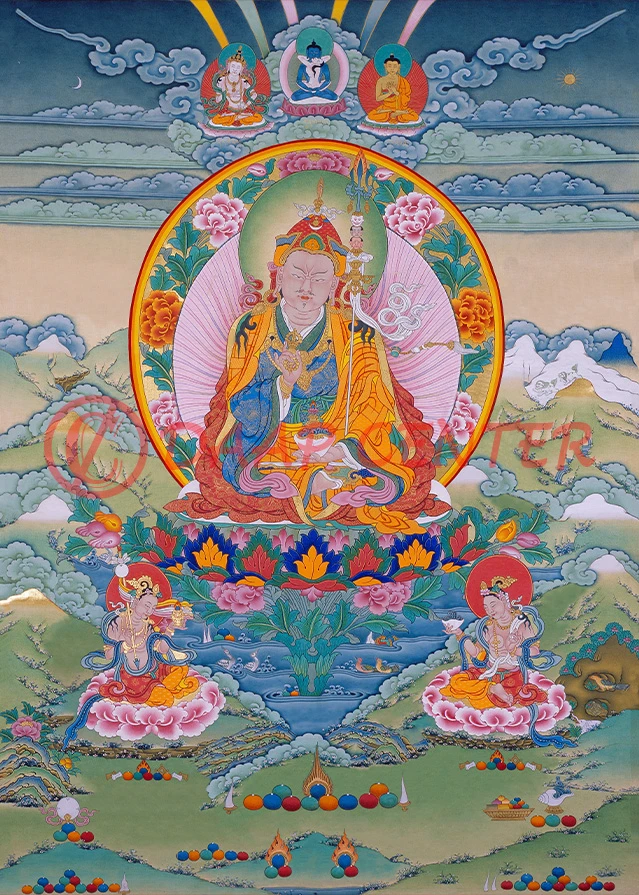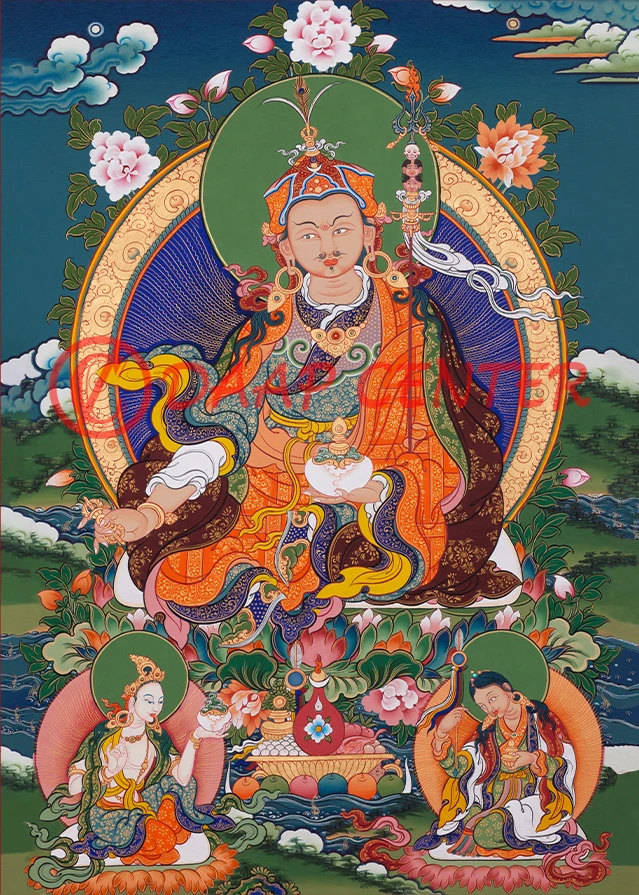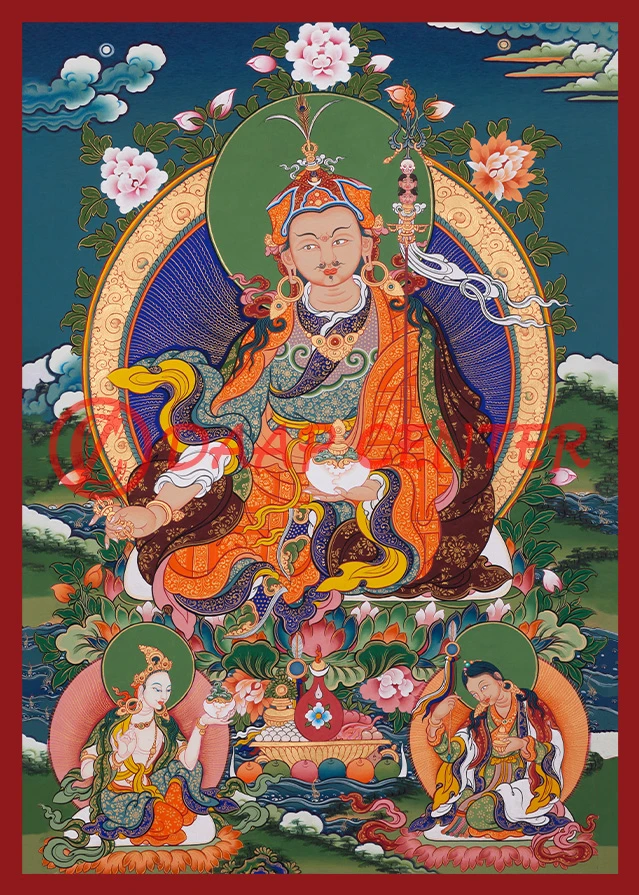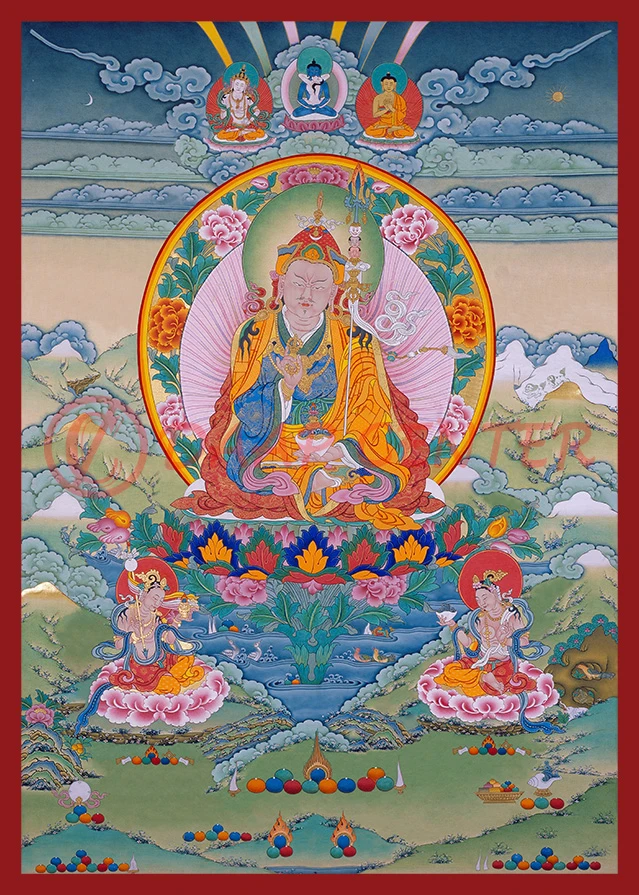
Guru Padmasambhava Depicted with his Consort, Mandarava and Yeshe Tsogyal
Guru Padmasambhava, also known as Guru Rinpoche in Tibetan, is a revered figure in Tibetan, his name means "Lotus-Born," reflecting his miraculous birth from a lotus flower. He is considered the "Second Buddha" die to his profound impact on the spread of Buddhism in Tibet. He is also referred to as the “Buddha of Three Times” in Tibetan Buddhism, holds, this title due to his profound influence across past, present, and future.
Past: In previous incarnations, Padmasambhava is believed to have appeared as significant figures and Bodhisattvas, contributing to the spread of Dharma and guiding beings toward enlightenment.
Present: In the 8th century, Padmasambhava was invited to Tibet by King Trisong Detsen. He played a crucial role in establishing Buddhism in Tibet, subduing local deities and negative forces to ensure the firm establishment of Buddhist teachings.
Future: Padmasambhava is prophesied to continue manifesting in the future to aid sentient beings, demonstrating his timeless commitment to guiding all beings towards enlightenment.
He is depicted seated in a lotus with royal posture, also known as the “European pose” or “posture of royal ease” (Sanskrit: “Lalit asana”).
In this posture: his right leg is bent and extended slightly outward with the foot resting on a lotus pedestal or cushion. While left leg is folded inward, with the foot resting on his right thigh or close to his body.
This pose conveys a sense of relaxed yet authoritative presence, symbolizing his readiness to teach and his royal status as a spiritual master. The gesture of his legs represents his accessibility and his active engagement in the world, combining both meditation and compassionate action.
His right hand holds a vajra, symbolizing the indestructible nature of diamond, representing the method or compassion aspect of the path.
His left hand cradles a skull-cup filled with nectar, signifying the wisdom aspect, and often includes the vase of longevity, brimming with the nectar of deathless wisdom and in his curve left arm, he often holds ‘khatvanga’ trident, symbolizing his mastery over the three realms.
He is adorned in elaborate brocade robes, reflecting his royal origins and the dignity of his teachings. The robes are typically in the distinctive Tibetan style, rich with symbolic meaning and intricate patterns.
On his head, he wears a tantric hat, which is often embellished with symbols such as the sun and crescent moon, indicating his yogic powers and spiritual attainments. An eagle feather may be seen surmounting the hat, representing his connection to the Dzogchen teachings, considered the pinnacle of his tantric wisdom. The vajra top of his hat signifies indestructible truth and Guru Padmasambhava’s role as a Vajra master, which is a feature not commonly found on other Buddhist deity’s hat.
Depicted alongside Guru Padmasambhava in this exquisite thangka are his two principal consorts, Mandarava and Yeshe Tsogyal. Both figures played essential roles in preserving and propagating his teachings, and their calm yet commanding presence underscores their profound place within the lineage. Their composed expressions convey deep wisdom and compassion, symbolizing the seamless transmission of enlightened insight.
Beyond its visual beauty, this sacred artwork serves as a powerful support for meditation and a source of inspiration for inner transformation and spiritual growth. A thangka is not merely a work of art, but a devotional object created to guide meditation and contemplation. Every element within the composition carries symbolic meaning, carefully designed to assist the practitioner on the spiritual path and to reveal the deeper significance behind the imagery.